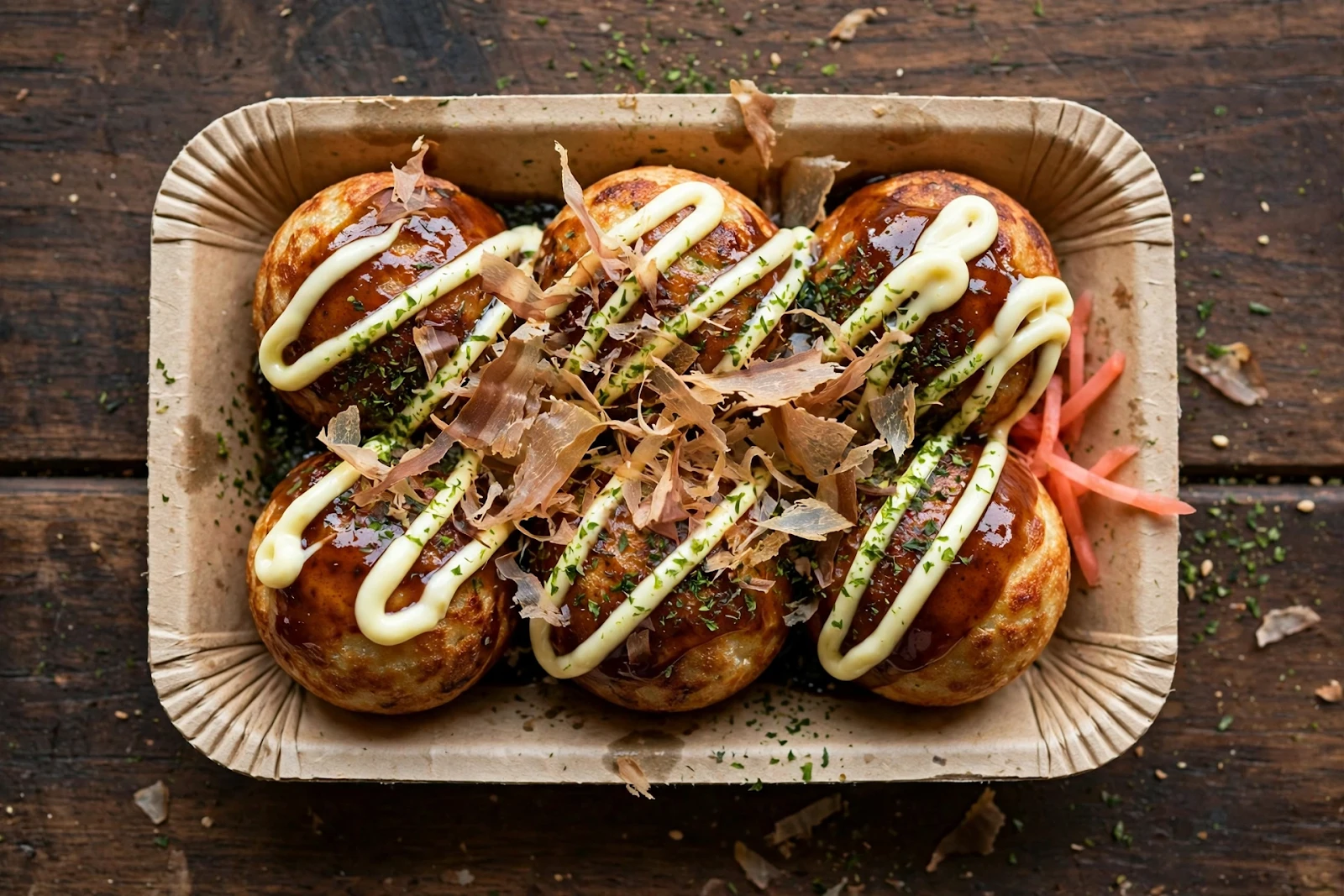
Okonomiyaki is Japan's beloved savory pancake — a thick, golden disc of shredded cabbage bound in a light batter, griddled until crisp at the edges and tender inside, then painted with tangy okonomiyaki sauce, a zigzag of mayonnaise, and a snowfall of dancing bonito flakes. The name means "grilled as you like it," and that is exactly the spirit: a flexible, forgiving recipe that turns humble cabbage into street-food gold.
This Osaka-style version adds thin slices of pork belly on top as the pancake cooks, so the fat renders into the batter and the pork crisps beautifully. It comes together in about 35 minutes with everyday ingredients, and it is endlessly adaptable — swap the pork for prawns, mushrooms or cheese and it is still unmistakably okonomiyaki.
Golden, saucy and loaded with toppings — Osaka's favorite pancake.
Recipe Info
- Prep time: 15 minutes
- Cook time: 20 minutes
- Total time: 35 minutes
- Servings: 4 (2 large pancakes)
- Calories: ~430 kcal per serving
Cabbage, batter and pork belly — everything a great okonomiyaki needs.
Ingredients
- 300 g / 10 oz green cabbage, finely shredded (about 4 cups)
- 100 g / 3/4 cup plain flour
- 120 ml / 1/2 cup dashi stock (or water)
- 2 large eggs
- 1 tsp soy sauce
- 1/2 tsp fine salt
- 100 g / 3 1/2 oz thinly sliced pork belly
- 2 spring onions, thinly sliced
- 1 tbsp pickled ginger, chopped
- 2 tbsp / 30 ml vegetable oil, for frying
- 4 tbsp okonomiyaki sauce (or tonkatsu sauce), for topping
- 3 tbsp Japanese mayonnaise, for topping
- 1 small handful bonito flakes, for topping
- 1 tsp aonori seaweed flakes (optional), for topping
Instructions
- Make the batter: Whisk the flour, dashi, eggs, soy sauce and salt in a large bowl until just smooth. A few small lumps are fine — overmixing makes the pancake tough.
- Fold in the cabbage: Add the shredded cabbage, spring onions and pickled ginger to the batter. Toss gently until every shred is lightly coated — the mixture should look mostly like cabbage, not like batter.
- Heat the pan: Warm 1 tablespoon of oil in a large non-stick frying pan over medium heat. The pan should be hot enough that a drop of batter sizzles, but not smoking.
- Shape the first pancake: Spoon half the cabbage mixture into the pan and press it into a thick, even round about 18 cm / 7 inches across. Lay half the pork belly slices over the top.
- Cook the first side: Cook for 5–6 minutes without moving it, until the underside is deep golden and crisp. Slide a spatula underneath to check before flipping.
- Flip and finish: Flip the pancake in one confident motion and cook for a further 5–6 minutes, until the pork is crisp and the center is cooked through. Repeat with the remaining mixture and pork.
- Top and serve: Transfer to plates, brush generously with okonomiyaki sauce, drizzle with mayonnaise, and scatter over bonito flakes and aonori. Cut into wedges and serve hot.

Crispy outside, soft and savory inside — the perfect slice.
Tips & Variations
- Shred the cabbage finely. Thin shreds cook through quickly and bind into a tender pancake; chunky pieces stay raw in the middle and fall apart.
- Don't press it flat. A thick, loosely packed pancake stays soft inside — squashing it with the spatula squeezes out the steam and makes it dense.
- Let it set before flipping. If the pancake resists the spatula, it needs another minute. A well-browned underside releases cleanly and flips in one piece.
- No pork? No problem. Prawns, squid, sliced mushrooms or grated cheese all work beautifully — or skip the topping entirely for a vegetarian version.
- Use two spatulas to flip. Slide one underneath and hold a second on top, then turn the whole pancake over confidently — hesitation is what breaks it.
- Make the sauce in a pinch. No okonomiyaki sauce? Stir together 3 tablespoons ketchup, 1 tablespoon Worcestershire sauce, 1 teaspoon soy sauce and 1 teaspoon honey.
- Keep them warm. Hold finished pancakes in a low oven (120 °C / 250 °F) while you cook the second one, so both hit the table hot.
Nutrition Note
Per serving, this okonomiyaki provides roughly 430 kcal, 15 g protein, 38 g carbohydrates and 24 g fat. Cabbage is the hero here — low in calories, high in fibre and vitamin C — while the egg adds protein and the pork belly brings satisfying richness. To lighten it, use lean ham or mushrooms instead of pork belly and go easy on the mayonnaise; the pancake stays just as satisfying.
Sponsored: see today's deals on recommended kitchen essentials
FAQ
What does okonomiyaki taste like?
Savory, slightly sweet and deeply umami — soft cabbage and egg inside, crisp edges outside, with tangy sauce, creamy mayo and smoky bonito on top.
Can I make okonomiyaki without dashi?
Yes — water works fine, though dashi adds a subtle savory depth. A pinch of instant dashi powder in water is an easy middle ground.
Is okonomiyaki gluten-free?
Not as written, since the batter uses wheat flour. Swap in a gluten-free flour blend and check that your soy sauce and okonomiyaki sauce are gluten-free.
Can I make okonomiyaki ahead of time?
The batter and shredded cabbage can be prepped a few hours ahead and kept covered in the fridge. Cook the pancakes fresh — they lose their crispness if held too long.
What is the difference between Osaka and Hiroshima okonomiyaki?
Osaka-style mixes everything into one batter pancake, as here. Hiroshima-style layers the ingredients with noodles and is flipped several times — delicious, but a bigger project.
Crisp edges, a soft savory heart, and toppings you can pile on exactly how you like them — okonomiyaki is weeknight cooking at its most fun. If you try it, tell us in the comments what you put on yours.




Comments
Post a Comment